
Table of Contents
- Why Teen Skin Needs Different Skincare Brands
- Ingredients to Avoid in Teen Skincare
- What Makes Skincare Products Safe for Teenage Girls
- How to Build a Simple Skincare Routine for Teens
- Comparing Teen Skincare Kits: What You Get and What It Costs
- Budget, Sustainability, and Social Media: What Parents Should Know
- When to See a Dermatologist for Teen Skin Concerns
- Conclusion: Choosing Brands That Support Healthy Habits
- Frequently Asked Questions
Last Updated: September 25, 2026
Why Teen Skin Needs Different Skincare Brands
Teen skin is not adult skin in a smaller package, and teen skincare brands built for grown-up concerns often do more harm than good. This guide from Journee Bloom breaks down how to choose teen skincare brands around what young skin actually needs: gentle formulas, short routines, and honest labeling. A harsh cleanser or trendy acid serum can strip the barrier and turn a manageable breakout phase into a months-long problem.
How Teen Skin Differs From Adult Skin
Teen skin has a thinner barrier and far more active sebaceous glands than adult skin. Hormonal shifts ramp up oil production, which is why the forehead, nose, and chin break out first. That oil is not the enemy; it is a sign of skin still developing.
The Dangers of Adult Multi-Step Regimens
A ten-step adult routine is the wrong tool for a teenager. Layering multiple actives, retinoids, strong acids, high-concentration vitamin C, increases irritation, redness, and barrier damage, making skin more sensitive and more breakout-prone, not less.
Ingredients to Avoid in Teen Skincare
Certain ingredients have no place in a beginner routine. The American Academy of Dermatology's guidance on skin care consistently points toward gentle, fragrance-free formulas for sensitive and young skin.
Watch for these when you shop:
- Harsh exfoliating acids at high concentrations, which can strip the barrier
- Added fragrance and essential oils, common triggers for irritation and allergic reaction
- Drying alcohols (denatured alcohol, isopropyl alcohol) near the top of an ingredient list
- Retinoids and prescription-strength actives without a dermatologist's direction
- Physical scrubs with rough particles, which create micro-tears on delicate skin
What Makes Skincare Products Safe for Teenage Girls
Safe skincare products for teenage girls share a few traits: short ingredient lists, no added fragrance, and formulas built for young skin. Look for non-comedogenic (won't clog pores), fragrance-free, hypoallergenic, and pH-balanced.
Reading Labels: Non-Comedogenic, Fragrance-Free, and Dermatologist-Tested
Here is a quick decision framework you can use in the aisle:
| Label term | What it means | Why it matters for teens |
|---|---|---|
| Non-comedogenic | Formulated not to clog pores | Reduces breakout risk |
| Fragrance-free | No added scent compounds | Lowers irritation risk |
| Dermatologist-tested | Evaluated under dermatological supervision | Signals some safety screening |
| pH-balanced | Matches skin's natural acidity | Supports the skin barrier |
| Hypoallergenic | Less likely to trigger reactions | Safer for sensitive skin |
What the Labels Legally Do and Do Not Mean
In the United States, the FDA regulates cosmetics for safety and labeling, but "hypoallergenic," "dermatologist-tested," and "non-comedogenic" are not standardized government definitions, they are marketing claims a brand applies to itself. "Fragrance-free" is closer to enforceable, but a product can still contain a masking fragrance. "Unscented" is the weaker cousin, it often means fragrance was added to neutralize odor.
A 60-Second Ingredient-List Read
Flip the bottle and scan in this order:
- First five ingredients. These are the highest-concentration ingredients. If denatured alcohol, isopropyl alcohol, or a strong acid sits here, put it back for a beginner.
- Fragrance and essential oils. Look for "fragrance," "parfum," lavender oil, citrus oils, and peppermint. These are common contact-irritant and allergy triggers on young skin.
- Active ingredients. Salicylic acid, benzoyl peroxide, and adapalene are legitimate acne actives, but concentration matters. A 2% salicylic acid cleanser is a reasonable starting point; a 10% leave-on peel is not.
- Preservatives at the end. Phenoxyethanol, parabens, and similar preservatives near the bottom are normal and generally fine, do not let a viral post scare you off a well-formulated product over them.
A Beginner's Glossary of Common Actives
Most guides hand teens a product list without explaining what the ingredients do, which is why teens over-apply things they do not understand. Here is the plain-language version:
- Salicylic acid, a beta-hydroxy acid that dissolves oil inside the pore. Best for blackheads and oily areas. Typical over-the-counter range is 0.5% to 2%.
- Benzoyl peroxide, kills acne-causing bacteria and reduces inflammation. Effective but drying; start at 2.5% rather than 10%.
- Adapalene, an over-the-counter retinoid at 0.1% gel. It speeds cell turnover and prevents new clogs, but causes a purge period and sun sensitivity, so it needs a slow ramp-up and daily sunscreen.
- Niacinamide, a form of vitamin B3 that supports the barrier and can help with oil control and redness. Usually well tolerated at 2% to 5%.
- Hyaluronic acid, a humectant that pulls water into the skin. It hydrates without adding oil, which suits teen skin.
- Ceramides, lipids that rebuild the barrier. Look for these in moisturizers if a teen's skin is irritated or over-exfoliated.
"Natural" and "clean" are not safety claims. Essential oils, botanical extracts, and "chemical-free" marketing say nothing about whether a product will irritate teen skin, and many plant oils are among the most common contact allergens. Judge the formula, not the story on the front.
Labels narrow the shelf; the ingredient list makes the decision. Teach your teen to read the back of the bottle and they can evaluate any brand, including ones that launch after this article is published.
How to Build a Simple Skincare Routine for Teens
The best routine for a teenager is short enough to stick with. Three steps, morning and night, cover the essentials without overwhelming young skin.
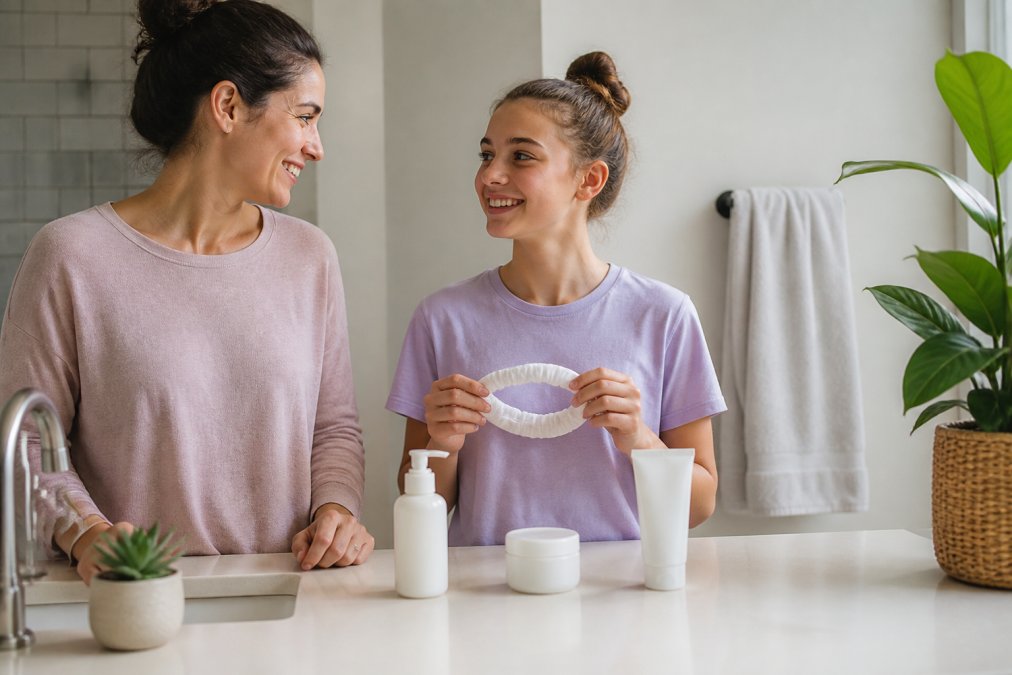
- Cleanse with a gentle, hydrating face wash to remove dirt and oil without stripping.
- Moisturize with a lightweight cream to support the skin barrier and lock in hydration.
- Protect with a broad-spectrum sunscreen every morning, rain or shine.
Keep the routine visible. A small caddy on the bathroom counter with three products removes the "where do I start" friction that kills consistency. The Starter Glow Kit from Journee Bloom was built around exactly this idea: cleanse, hydrate, moisturize, done.

Comparing Teen Skincare Kits: What You Get and What It Costs
A pre-built kit removes the guesswork of matching a cleanser to a moisturizer to a sunscreen. Here is how the two Journee Bloom starter options compare:
| Kit | Price | What's Included | Best For |
|---|---|---|---|
| Starter Glow Kit | $98.00 | Glow Wash, Bloom Glow Cream, Bloom Hydrating Mist, headband, wristlets, glow bag, under-eye patches, sheet mask, video tutorials | Tweens and teens just beginning skincare |
| Ultimate Glow Kit | $179.00 | Everything in the Starter Kit plus Glow Serum, acne patches, Strawberry Glow Balm, travel face towels, affirmation keychain | Teens ready for a slightly fuller routine with occasional breakout care |
Budget, Sustainability, and Social Media: What Parents Should Know
Three forces shape what your teen brings home: cost, values, and the algorithm. All three are manageable with planning.
Managing Costs Without Sacrificing Safety
A simple routine is also a cheaper routine. Three well-chosen products cost less over a year than a rotating pile of trendy items that get abandoned. Build the habit first, then expand only if your teen's skin needs more.
- Set a monthly ceiling, not a per-product limit. A drugstore cleanser, moisturizer, and sunscreen runs roughly $25 to $45 total per month.
- Separate "restock" from "experiment." Essentials get replaced automatically; new products come from a smaller "try" budget so a viral serum does not crowd out the sunscreen your teen needs.
- Compare cost per ounce, not sticker price. A $12 cleanser at 3 ounces costs more per use than a $16 cleanser at 8 ounces.
- Watch for the subscription trap. Auto-ship programs discount the first order then bill monthly. Check the cancel window before signing up.
- Buy the active, not the packaging. A generic 2.5% benzoyl peroxide treatment does the same job as a scented, influencer-branded version at several times the price.
Sustainability and Ethical Sourcing: What Gen Z Actually Asks
Teens are the most values-driven buying group in the household, and they will ask questions most parents are not ready for: Is this tested on animals? Is the packaging recyclable? Where is it made? Brands that answer clearly earn loyalty; brands that greenwash lose it fast.
A few honest ground rules:
- "Recyclable" is not the same as "recycled." A bottle marked recyclable still ends up in a landfill if your local program does not accept that plastic type. Check your municipality's accepted list.
- Refillable and concentrated formats cut packaging and shipping weight, which usually cuts cost too. They are worth the switch once a teen has a routine they will keep.
- "Cruelty-free" and "vegan" are separate claims. A product can be vegan (no animal ingredients) and still tested on animals. Look for both if that matters to your family.
- Beware vague certifications. A logo with no verifiable standards behind it is decoration. Recognized third-party certifications are the ones worth trusting.
When Social Media Trends Push Unsafe Products
The Federal Trade Commission's guidance on advertising and endorsements exists precisely because influencer posts are not always honest about what a product does. Viral "skin cycling" or high-strength acid routines are designed for adult skin and can damage a teen's barrier. Teach your teen one rule: if a product promises to fix everything in a week, it is a red flag.
- Paid partnerships are not always disclosed. If a creator links a product in every video, assume a commercial relationship until proven otherwise.
- "Before and after" photos are frequently lit, filtered, or taken weeks apart. They are not evidence.
- Trend cycles are shorter than skin cycles. A product that trends for three weeks cannot have been used long enough to prove it works. Skin needs six to eight weeks to show real change.
- The algorithm rewards novelty, not safety. New actives and higher concentrations get more engagement, which is exactly why teens are pushed toward formulas that are too strong for them.
Social media trends often push products with no age guidance at all. Before buying anything your teen saw online, check the ingredient list for fragrance, drying alcohols, and strong acids, and run a patch test first.
Give your teen a script for the store: "I am looking for a fragrance-free cleanser, a light moisturizer, and a broad-spectrum SPF 30 or higher." A teen who can name what they need is far less likely to be sold what they do not.
Budget, values, and the algorithm are not separate problems. A teen who understands cost per use, asks real sustainability questions, and recognizes a paid post is equipped to choose brands on their own, which is the actual goal.
When to See a Dermatologist for Teen Skin Concerns
Some skin concerns need a professional, not a new product. See a dermatologist if your teen has deep, painful cysts, widespread breakouts that do not respond to a gentle routine after a few months, sudden severe irritation, or scarring, or if over-the-counter options are not working or are making things worse.
Conclusion: Choosing Brands That Support Healthy Habits
The hardest part of teen skincare is not finding products; it is finding brands that respect how young skin actually works. Harsh formulas, ten-step routines, and trend-chasing all work against building a habit your teen will keep.
Frequently Asked Questions
What ingredients should teens avoid in skincare products?
Teens should avoid harsh exfoliants like walnut scrubs, high concentrations of retinol, essential oils that can irritate sensitive skin, and drying alcohols. Also skip products with added fragrance if skin is acne-prone or sensitive. Look for gentle cleansers, non-comedogenic moisturizers, and broad-spectrum sunscreen instead. A patch test on the inner arm can help identify reactions before applying to the face.
How do I know if a skincare product is safe for sensitive teen skin?
Check for labels like fragrance-free, hypoallergenic, non-comedogenic, and dermatologist-tested. These terms indicate the product has been formulated to reduce irritation risk. Avoid products with long ingredient lists full of active ingredients. Start with a gentle cleanser and moisturizer, then add one product at a time. If redness or stinging occurs, stop use and consult a dermatologist.
What is the difference between adult and teen skincare formulations?
Adult formulations often contain stronger active ingredients like retinol, glycolic acid, and vitamin C at higher concentrations. Teen skin is still developing and has a more delicate barrier, so it needs gentler formulas. Teen skincare brands focus on hydration, gentle cleansing, and oil control without stripping the skin. Using adult anti-aging products on young skin can cause irritation, dryness, and barrier damage.
At what age should a child start a skincare routine?
Most dermatologists suggest a basic routine can start around age 8 to 10 with just a gentle cleanser and moisturizer. Sunscreen should be introduced earlier as part of outdoor habits. A full routine with more steps can wait until puberty brings oilier skin or breakouts. The goal is building healthy habits, not adding complexity. Parents should guide tweens through each step until they can do it independently.
Should teens use anti-aging products?
No. Teen skin does not need anti-aging ingredients like retinol or peptides. These can irritate young skin and disrupt the skin barrier. Teens should focus on cleansing, moisturizing, and sun protection. Preventative care like daily broad-spectrum sunscreen is the best anti-aging step for any age. Save anti-aging products for later in life when skin actually needs them.
How can parents identify non-toxic skincare brands for tweens?
Look for brands that disclose full ingredient lists, avoid known irritants like parabens and phthalates, and use gentle botanical ingredients. Brands created by estheticians or dermatologists often provide more transparency. Check for third-party testing or certifications. Read customer reviews about sensitivity. When in doubt, choose fragrance-free and hypoallergenic options, and patch test before full use.
Choosing the right teen skincare brands comes down to one question: does this product help my child build a healthy habit, or does it add pressure and complexity? Journee Bloom exists to make that answer easy, with gentle, age-appropriate formulas and simple routines that support confidence without the pressure of perfection. Get started with Journee Bloom and give your teen a routine they will actually keep.