
Table of Contents
- The Real Reason Teen Skincare Habits Matter Now
- Step 1: Identify Your Skin Type Before Buying Anything
- Step 2: Build a Simple Skincare Routine for Lazy Teens
- Step 3: Understand the Morning vs Evening Skincare Routine for Teens
- The Most Common Skincare Mistakes to Avoid as a Teen
- How Parents Can Support Habits Without the Pressure
- Your First Week: A Simple Checklist to Get Started
- Frequently Asked Questions
Last Updated: September 4, 2026
Teenage skin changes fast, and a thoughtful routine keeps up with it. Starting a teen skincare habit early is less about chasing perfect skin and more about building a foundation of self-care that respects how delicate young skin actually is. This guide from Journee Bloom, created by esthetician moms, shows you how to start without the pressure, clutter, or expensive mistakes. We'll cover skin types, a routine simplified for lazy teens, and the morning vs evening split that matters.
The biggest misconception is that teens need a 10-step regimen or aggressive anti-aging actives. They don't. Over-treating young skin can damage the skin barrier and create the very breakouts and irritation you're trying to fix. A simple, consistent approach wins every time.
The Real Reason Teen Skincare Habits Matter Now
Hormonal shifts during the teenage years ramp up oil production, often leading to clogged pores and acne. A consistent routine helps manage oiliness and supports the skin's natural pH balance, but the habit itself is the real prize, building discipline that translates into confidence.
Skincare shouldn't feel like a punishment for having breakouts. It should be a few minutes of calming self-care that makes you feel fresh and in control. Framed as preventative care rather than a fix for flaws, the habit sticks because it feels good.
Starting early also means you learn what your skin needs before adult products tempt you with harsh active ingredients like retinol. For most teens, a gentle cleanser, a lightweight moisturizer, and daily SPF are the entire foundation.
Step 1: Identify Your Skin Type Before Buying Anything
You can't build a routine without knowing what you're working with. Most teens fall into one of four categories: oily, dry, combination, or sensitive. A quick test: wash your face with water only, pat dry, and wait an hour. If your T-zone is shiny, you're oily. If everything feels tight, you're dry. Shine in the middle but tight cheeks means combination, and any redness or stinging points to sensitive skin.
Whatever your skin type, keep the cleanser gentle. Oily, dry, combination, and sensitive skin all do best with a fragrance-free formula that cleans without stripping. Our Glow Wash is fragrance-free, sulfate-free, and pH-balanced, and it works for every skin type, so there is no need to guess.

Step 2: Build a Simple Skincare Routine for Lazy Teens
A simple skincare routine for lazy teens is three steps: cleanse, moisturize, protect. No serums, no toners, no 12-step nonsense. Morning and night, wash your face and apply a light moisturizer. In the morning, finish with sunscreen, that single habit prevents sun damage and keeps skin balanced.
The Glow Wash from Journee Bloom is a gentle cleanser that works for every skin type. It removes daily dirt and oil without leaving skin tight or stripped, and it is designed specifically for delicate young skin. After cleansing, a lightweight moisturizer like the Glow Cream locks in hydration without feeling greasy or heavy.

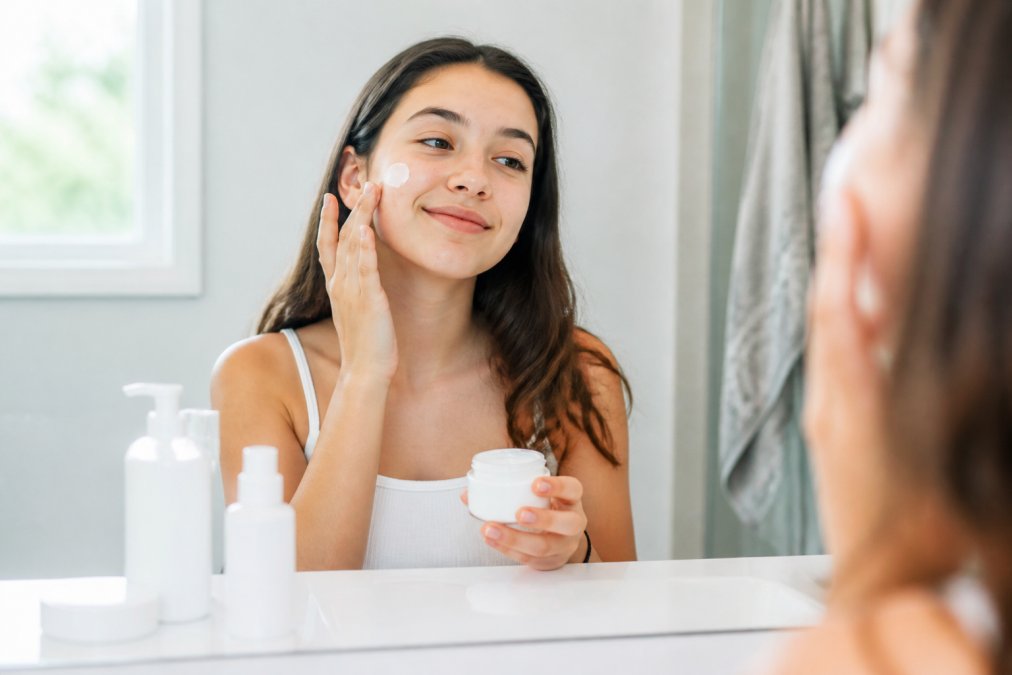
Consistency beats perfection. A routine you do every day is worth infinitely more than an elaborate one you skip by Wednesday. Keep products visible on the counter as a visual reminder.
Step 3: Understand the Morning vs Evening Skincare Routine for Teens
The morning vs evening skincare routine for teens serves different purposes. Mornings are about protection: cleanse, moisturize, and apply SPF 30 or higher. Evenings are about repair: cleanse to remove sweat, oil, and makeup, then moisturize to support overnight recovery.
Makeup removal is non-negotiable at night, sleeping in makeup clogs pores and causes breakouts. If you wear heavy makeup, a gentle cleanser may not be enough; you'll need a dedicated makeup remover first. For acne-prone teens, evening cleansing is the most important step to prevent pore clogging.
Consistency between morning and night matters more than product count. Many teens skip the evening cleanse when tired, but that's the routine that prevents the most breakouts.
The Most Common Skincare Mistakes to Avoid as a Teen
Skincare mistakes to avoid as a teen usually stem from doing too much, not too little. Over-exfoliation is the biggest offender, physical scrubs and chemical exfoliants used daily damage the skin barrier, causing redness and irritation. Exfoliate at most once a week, and only if your skin tolerates it.
Other common errors include popping pimples, which spreads bacteria and causes scarring, and skipping sunscreen on cloudy days. UV damage is cumulative, and daily SPF is the single most effective anti-aging and skin health measure.
But the most pervasive mistake isn't a product choice, it's the mindset that drives you to buy the wrong products. The 'TikTok effect' has created a generation of teens who believe a 10-step routine with active ingredients like retinol, vitamin C serums, and chemical exfoliants is normal. It isn't. Most of those products are formulated for adult skin that produces less oil and has a more resilient barrier. Applied to teenage skin, they can cause chemical burns, contact dermatitis, and 'over-exfoliation syndrome', where the skin becomes red, shiny, and painfully sensitively because its protective outer layer has been stripped away.
A common pattern dermatologists see is a teen who watches a 'get ready with me' video featuring a 25-year-old influencer with a $400 skincare shelf, then tries to replicate it with drugstore dupes, often making the original acne worse. The FDA does not regulate cosmetics as strictly as drugs, so products can be marketed as 'gentle' or 'for all skin types' without rigorous testing (the FDA). Be your own skeptic.
Here's a concrete rule of thumb: if a product claims to 'transform' your skin in 7 days, 'detoxify' your pores, or 'erase' texture, it's overpromising. Real skincare is slow. The only ingredient with substantial clinical evidence for treating teen acne is benzoyl peroxide (typically 2.5% to 5%) or salicylic acid (0.5% to 2%), used as a spot treatment, not all over your face, not every day, and never combined with other active ingredients.
Another rarely discussed mistake is the financial trap. Instead of buying a new product every time a video goes viral, commit to using what you have for at least 30 days before adding anything. This 'one in, one out' rule keeps your routine simple and your wallet intact.
Finally, avoid the 'skincare as self-punishment' trap. If you're using harsh products because you feel 'gross' or 'disgusting' about your skin, that's a sign to step back. Skincare should feel neutral at worst and calming at best. If a product stings, burns, or makes you feel worse, it's not working, even if it's trending.
How Parents Can Support Habits Without the Pressure
Parents play a crucial role in helping teens build habits without making skincare feel like a critique of their appearance. Focus on health and routine, not on fixing flaws. Frame it as "taking care of your skin" rather than "clearing up your acne."
Buy the products together and let your teen choose scents and textures they enjoy. If they like the product, they'll use it. Journee Bloom products are designed for tweens and teens with gentle botanical ingredients, and they're Journee approved for scent, texture, and detail, making them appealing rather than medicinal.
Keep the routine budget-conscious. A basic routine of cleanser, moisturizer, and SPF doesn't need to cost a fortune, and consistency with affordable products beats occasional use of luxury items. The Glow Kit bundles the essentials into one complete set, which simplifies the decision and removes the guesswork for parents who want peace of mind about what their kids are putting on their skin.

But here's what most parenting guides miss: the single most powerful thing you can do is model the behavior yourself. If you complain about your own wrinkles, dark spots, or breakouts, your teen internalizes that skin is something to be anxious about. If you wash your face twice a day without commentary, apply sunscreen without drama, and never mention 'flaws,' your teen learns that skincare is just hygiene, like brushing your teeth. Use that power by example, not by lecture.
Second, separate the 'shopping conversation' from the 'habit conversation.' Don't buy a full routine on day one. Start with just a cleanser and moisturizer for two weeks. When that becomes automatic, add SPF. When that sticks, add a spot treatment if needed. This staggered approach costs less upfront and builds habits in small, manageable steps, preventing the 'shiny new thing' effect where a teen uses a product three times and abandons it.
Third, have a direct conversation about social media pressure. Ask your teen: 'What are you seeing online about skincare that makes you feel like you need to do more?' Listen without judgment. Then explain that most influencers are paid to promote products, and their skin is often filtered, edited, or enhanced with professional treatments. The Federal Trade Commission requires influencers to disclose paid partnerships, but many use vague language like 'obsessed with this' or 'my holy grail' that doesn't clearly signal an ad. Teach your teen to look for #ad, #sponsored, or 'paid partnership' tags, and to be skeptical of any product that appears in every video.
Finally, set a budget together and stick to it. If your teen wants a more expensive product, ask them to explain what it does differently and whether the ingredient list justifies the price. This teaches critical thinking about marketing claims and prevents impulse purchases driven by FOMO.
Your First Week: A Simple Checklist to Get Started
Here's your actionable plan for the next seven days. Print it, screenshot it, or stick it on the bathroom mirror.
| Day | Morning Routine | Evening Routine | Focus |
|---|---|---|---|
| Day 1-2 | Cleanse, moisturize, SPF | Cleanse, moisturize | Build the rhythm |
| Day 3-4 | Cleanse, moisturize, SPF | Cleanse, moisturize | Notice how skin feels |
| Day 5-7 | Cleanse, moisturize, SPF | Cleanse, moisturize | Consistency wins |
- Wash your face every morning and night
- Apply moisturizer while skin is still slightly damp
- Use SPF every morning, even indoors
- Never sleep in makeup or sunscreen
- Keep a spot treatment for active breakouts only
- Resist the urge to pop pimples or over-exfoliate
Dermatologists consistently emphasize that a gentle, consistent routine protects skin health far better than aggressive treatments. As noted in guidance from the American Academy of Dermatology on teen skincare, a simple routine with a gentle cleanser and moisturizer is the recommended starting point for most young skin. For teens managing acne, the American Academy of Dermatology's acne resources suggest starting with noncomedogenic products to avoid clogging pores.
If you stick with this for a week, you'll notice your skin feels calmer and more balanced. That feeling is the habit forming. By the end of the month, it becomes automatic, that's the real win. For a routine that handles breakouts without stripping skin, the Acne Patches are a fun, effective way to keep fingers off blemishes while they heal. Healthy skin is a long game, and starting now sets the tone for a lifetime of good habits.
Building a teen skincare habit doesn't require a cabinet full of products or a complicated schedule. It requires the right basics, a consistent rhythm, and a mindset that treats skincare as self-care rather than a fix for flaws. Journee Bloom's esthetician-mom-formulated line simplifies this with gentle botanical products designed for tweens and teens, plus access to private YouTube tutorials. Get started with Journee Bloom and give your teen a routine that supports calm, hydrated, balanced skin and confidence without the pressure of perfection.
Frequently Asked Questions
What should a 14 year old's skincare routine be?
A 14 year old's routine should be simple: a gentle cleanser morning and night, a lightweight moisturizer to keep the skin barrier healthy, and SPF during the day. That's the core. You only need to add an acne spot treatment if you have active breakouts. Avoid strong active ingredients like retinol or harsh exfoliants at this age. Consistency with these three steps does more for your skin than a cabinet full of trendy products.
How can teens build consistent skincare habits without feeling overwhelmed?
Attach your routine to habits you already have. Wash your face right after brushing your teeth in the morning and right before getting in the shower at night. Keep your cleanser and moisturizer visible on the counter so you do not forget them. If you are lazy or busy, a minimalist routine with just two or three products is much easier to stick to than a ten-step process. Missing a day is normal, just get back to it the next day.
What are the most common skincare mistakes to avoid as a teen?
The biggest mistake is over-washing or using harsh, adult-formulated products that strip your skin and damage your barrier. Another common error is skipping moisturizer because your skin feels oily; this actually makes oil production worse. Popping pimples leads to scarring, so use a spot patch instead. Finally, do not introduce too many new active ingredients at once. Start simple and patch test anything new to see how your skin reacts.
Why is SPF important even for teens who do not spend much time outside?
Daily SPF is preventative care that matters long before you see sun damage. UV rays reach your skin through windows, and exposure during your teenage years accumulates over time. Sun damage is a leading cause of premature aging and dark spots later in life. Getting into the habit of applying a moisturizer with SPF every morning is the single most effective anti-aging step you can take. It is also essential for protecting acne marks from darkening.
This article was written using GrandRanker