
Table of Contents
- What Non-Comedogenic Really Means for Tween Skin
- How to Choose the Best Moisturizer for Teenagers and Tweens
- A Non-Comedogenic Moisturizer for Acne-Prone Skin
- Why an Oil-Free Moisturizer for Young Teens Matters
- Building a Simple Skincare Routine for Tweens
- Patch Testing and Introducing New Products Safely
- When Acne or Irritation Needs Professional Care
- Conclusion
- Frequently Asked Questions
Last Updated: October 17, 2026
What Non-Comedogenic Really Means for Tween Skin
A non-comedogenic moisturizer is a face cream formulated to avoid ingredients that commonly clog pores. That is the whole promise, and it is narrower than most packaging suggests.
Here is the part most guides skip: "non-comedogenic" has no binding legal definition in the United States. The U.S. Food and Drug Administration's guidance on cosmetic labeling covers how cosmetics are labeled and marketed, but it does not certify comedogenicity claims.
That does not make the label useless, just a starting point, not a finish line.
What the Claim Can and Cannot Promise
A non-comedogenic claim is a statement about likely pore behavior for most people, not a guarantee for your tween. Four limits matter for young, changing skin:
- It says nothing about irritation. A cream can be non-comedogenic and still sting sensitive skin. Irritation and clogging are different problems with different triggers.
- It says nothing about fragrance. Fragrance is a common trigger for irritation and is not a classic pore-clogger, so it slips past the claim entirely. A fragrance-free formula is a separate check.
- It is not a ranking. Two non-comedogenic creams are not equally suitable for a 12-year-old with oily skin and a 12-year-old with dry patches. The label filters the shelf; it does not sort it.
Why a "Non-Comedogenic" Cream Can Still Cause Breakouts
This is the question parents ask most, and the honest answer has three parts. Individual reactions vary: an ingredient low on published comedogenicity scales can still disagree with one person's skin.
A common pattern practitioners describe is a tween who switches three products in one week, breaks out, and blames the moisturizer. Change one product at a time so you can actually tell what happened.
How to Read an Ingredient List
Ingredient lists run in descending order of concentration until the 1% mark, after which order is up to the brand. The first five ingredients tell you most of what a cream actually is.
What to look for depends on the skin in front of you:
- Oily or blemish-prone: lightweight bases, gel cream textures, and labels that say oil-free
- Dry or tight: ceramides, hyaluronic acid, and nourishing oils listed early
- Sensitive: fragrance-free formulas, short ingredient lists, fewer botanicals
A common mistake is buying the longest ingredient list on the shelf. For a tween just starting out, shorter is usually kinder.
How to Choose the Best Moisturizer for Teenagers and Tweens
The best moisturizer for teenagers and tweens is one that matches their skin type, absorbs without a greasy film, and contains no fragrance if their skin reacts easily.
We would rank the criteria in this order:
| Priority | What to Check | Why It Matters |
|---|---|---|
| 1 | Skin type match | Oily skin needs gel cream; dry skin needs ceramides and oils |
| 2 | Fragrance-free | Reduces irritation risk on young, reactive skin |
| 3 | Non-comedogenic claim | Filters out heavy pore-clogging bases |
| 4 | Lightweight texture | Tweens abandon anything that feels like a mask |
| 5 | Price per ounce | Daily use means frequent repurchasing |
Notice that "best" never means most expensive. A tween who will actually apply a $26 cream twice a day beats one who owns a luxury jar she avoids because it feels heavy.
How We Evaluate a Moisturizer
Most roundups list products without saying how they were judged. Here is our method.
- Non-comedogenic evidence. We check whether the formula avoids ingredients commonly flagged on published comedogenicity scales, whether the brand states a testing method, and whether the claim is paired with oil-free or fragrance-free language. A claim with no supporting detail ranks weaker.
- Ingredient review. We read the first five ingredients, confirm the base matches the skin type the product is aimed at, and flag fragrance, essential oils, and drying alcohols for sensitive skin.
- Texture and wearability. A moisturizer a tween won't wear is a failed product. We favor gel creams and lotions that absorb quickly and sit well under sunscreen.
- Price per ounce. We calculate cost per ounce rather than sticker price, because daily use means frequent repurchasing. A $26 cream in a 1.7 oz jar costs about $15 per ounce; a $12 lotion in a 4 oz bottle costs about $3 per ounce. Both can be reasonable, compare like with like.
Match the Texture to the Skin
Skin type is the first filter, and texture is the fastest way to read it:
- Oily or combination: gel cream, fluid, or lotion labeled oil-free. These absorb fast and don't sit on top of sebum.
- Dry or tight: cream or lotion with ceramides, hyaluronic acid, or nourishing oils listed early. Rich balms are usually too much for a first routine.
- Sensitive or reactive: fragrance-free, short ingredient list, fewer botanicals. Patch test before full-face use.
- Normal, just starting out: a lightweight lotion is the safest default; it works for most tweens and is easy to replace if skin changes.
A Note on Price and Repurchasing
Tweens go through moisturizer faster than adults expect. A pea-sized amount is enough for the face; a dime-sized amount covers face and neck. Buying the smallest size first confirms the texture works before you commit to a larger jar.
A Non-Comedogenic Moisturizer for Acne-Prone Skin
For acne-prone skin, the goal is hydration without adding fuel. A non-comedogenic moisturizer for acne-prone skin should be oil-free or low in heavy oils, absorb quickly, and support the skin barrier rather than strip it.
Here is the counterintuitive part. Skipping moisturizer makes oily skin worse. When skin feels tight and dry, it compensates.
What we look for in this category:
- Gel cream or lotion textures rather than rich balms
- Barrier support from ceramides or hyaluronic acid
- No added fragrance
- Salicylic acid only if tolerated, and never layered with other actives at the start
If your tween is using a prescription acne treatment, ask the prescribing clinician which moisturizer to pair with it. Some actives need a plain, gentle cream and nothing else.
Why an Oil-Free Moisturizer for Young Teens Matters
An oil-free moisturizer for young teens hydrates without leaving a residue that traps sebum and dead skin cells. During puberty, rising hormone levels including testosterone increase sebum output, which is why breakouts and shine appear around ages 9 to 13 for many kids. That is a normal developmental shift, not a hygiene failure, and it changes what a moisturizer needs to do.
Lightweight does not mean ineffective. A silky, fast-absorbing cream can deliver lasting moisture while letting skin breathe. Look for:
- Gel cream or fluid textures
- Hyaluronic acid for water-based hydration
- Quick absorption with a soft, not shiny, finish
Building a Simple Skincare Routine for Tweens
A simple skincare routine for tweens needs three steps in the morning and two at night. Complexity is the enemy of consistency at this age.
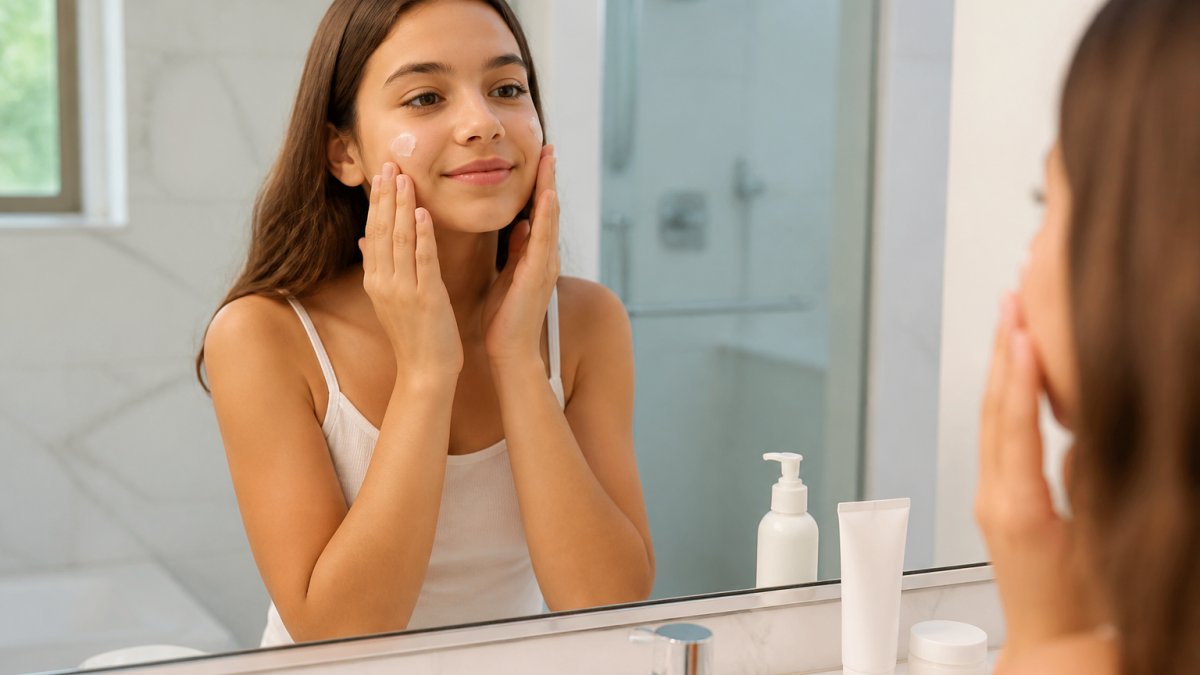
Morning:
- Rinse with lukewarm water or a gentle cleanser
- Apply a lightweight moisturizer
- Apply sunscreen, every day
Night:
- Cleanse to remove sunscreen and oil
- Apply moisturizer
A gentle cleanser, a moisturizer, and daily SPF form the foundation most estheticians recommend for young skin. Our Glow Cream was built for exactly this slot: a lightweight daily moisturizer for tweens and teens that absorbs quickly and pairs with a simple cleanser and SPF.

Patch Testing and Introducing New Products Safely
Patch testing means applying a small amount of a new product to a limited area and watching for a reaction before using it on the whole face.
Here is the method we recommend:
- Apply a pea-sized amount behind the ear or on the inner forearm
- Leave it for 24 hours without washing the area
- Check for redness, itching, stinging, or swelling
- If clear, repeat on the jawline for two more days
Introduce one new product at a time. If a tween starts a cleanser, a moisturizer, and a serum in the same week and breaks out, nobody can tell which one caused it.
Parents often ask how to get a kid to stick with it. Tie the routine to something that already happens, like brushing teeth.
When Acne or Irritation Needs Professional Care
Some skin issues need a clinician, not a better moisturizer. See a dermatologist or pediatrician if you notice:
- Cystic or deep, painful bumps rather than surface whiteheads
- Scarring beginning to form
- No improvement after 8 to 12 weeks of a consistent gentle routine
- Sudden severe irritation from a product, especially with swelling
A moisturizer manages hydration. It does not treat moderate to severe acne, and no cream on a shelf should be expected to. The American Academy of Dermatology's guidance on acne care is a solid starting point for understanding when to escalate.
If a product causes a reaction, stop using it and note the ingredients. That record helps a clinician identify the trigger.
Conclusion
The hardest part of buying skincare for a tween is not finding a cream, it is filtering out the noise, the promises, and the pressure.
At Journee Bloom, we build for the tween who needs something gentle, simple, and genuinely suited to young skin.
Start with the basics, patch test everything, and let consistency do the work. Shop now to build your tween's first real routine.
Frequently Asked Questions
Can tweens use moisturizer if they have acne-prone skin?
Yes. Acne-prone skin still needs hydration, and skipping moisturizer can make oil production worse. The key is choosing a non-comedogenic moisturizer for acne-prone skin, which means it is formulated not to clog pores. Look for lightweight, oil-free formulas with ingredients like ceramides or hyaluronic acid that support the skin barrier. Apply a small amount morning and evening after cleansing. If breakouts are severe or leave scars, talk to a dermatologist about a treatment plan that fits your child's age.
How often should a tween apply face moisturizer?
Twice a day is enough: once in the morning and once at night after cleansing. A pea-sized amount covers the whole face. More frequent application usually is not needed unless a dermatologist recommends it for dry patches. Pairing moisturizer with daily sunscreen in the morning protects the skin barrier and helps prevent irritation. Keep the routine simple so it is easy to repeat consistently, which matters more than using many products.
Do tweens need a separate face moisturizer from body lotion?
Yes, a separate face moisturizer is worth it. Facial skin is thinner and more prone to clogged pores than body skin, and body lotions often contain heavier oils and fragrances that can trigger breakouts on the face. A non-comedogenic moisturizer made for young skin, like a lightweight gel cream, absorbs quickly and hydrates without a greasy feel. Body lotion can stay for arms and legs, while the face gets its own gentle formula.
What should tweens look for in a non-comedogenic moisturizer?
Look for oil-free or lightweight formulas labeled non-comedogenic, fragrance-free options for sensitive skin, and barrier-supporting ingredients like ceramides or hyaluronic acid. Avoid heavy creams, strong acids, and anti-aging ingredients not meant for young skin. A short ingredient list is easier to check. Patch test on the inner arm for 24 to 48 hours before applying to the face, and introduce one new product at a time so you can tell what works.