
Table of Contents
- Why Tween Skin Is Different
- What 'Clean Skincare' Actually Means
- Skincare Ingredients to Avoid for Kids
- A Simple Skincare Routine for 10 Year Olds
- Dermatologist Recommended Skincare for Tweens
- The Psychological Impact of Skincare Trends on Tweens
- How to Talk to Your Tween About Skincare
- Frequently Asked Questions
Last Updated: September 29, 2026
Why Tween Skin Is Different
Tween skin is not simply smaller adult skin. It is thinner, more reactive, and entering a decade of hormonal change that shifts oil production, barrier strength, and sensitivity in ways that adult formulas were never designed to handle. That single fact is why the question "is clean skincare safe for tweens" has a more nuanced answer than most product labels suggest.
Three things change around ages 9 to 12:
- Sebum production rises. Androgens begin signaling oil glands before visible breakouts appear.
- The skin barrier is still maturing. A developing barrier loses moisture faster and reacts to irritants more sharply.
- The skin microbiome is stabilizing. Harsh cleansers strip the organisms that keep skin balanced.
What 'Clean Skincare' Actually Means
Clean skincare is a marketing term, not a regulated one. No government body defines which products qualify, so any brand can print "clean" on a label without meeting a standard. That is the first thing parents need to understand.
What "clean" often signals in practice:
- A shorter ingredient list
- No synthetic fragrance or dyes
- No parabens or phthalates
- Plant-derived rather than petroleum-derived ingredients
How to Read a Tween Skincare Label in 60 Seconds
Instead of trusting the front of the bottle, flip it over. The ingredient list is ordered by concentration, so the first five ingredients tell you most of what you need to know.
A quick scan:
- Find the first five ingredients. If water, glycerin, or a gentle emollient leads the list, you are usually in safe territory. If denatured alcohol or a strong acid leads, set it down.
- Check for fragrance near the top. "Fragrance" or "parfum" in the first third of the list is a red flag for reactive tween skin.
- Look for the words that mean nothing. "Clean," "pure," "botanical," "dermatologist-inspired," and "toxin-free" are marketing, not standards. "Toxin-free" in particular has no legal meaning in cosmetics.
- Look for the words that mean something. "Fragrance-free," "non-comedogenic," "hypoallergenic," and "pH-balanced" describe testable properties.
- Check the expiration or period-after-opening symbol. An open-jar icon with a number tells you how many months the product stays stable after opening. Most tween products should be replaced within 6 to 12 months.
Certifications Worth Knowing
No single seal guarantees a product is right for your child, but a few carry real criteria behind them:
- National Eczema Association Seal of Acceptance, products must meet ingredient and testing criteria that exclude many common irritants.
- EPA Safer Choice, applies mainly to cleaning products, not skincare, but useful to know so you do not mistake it for a cosmetic standard.
- USDA Organic, refers to agricultural ingredients, not to safety for skin. A product can be organic and still irritating.
Skincare Ingredients to Avoid for Kids
The ingredients to avoid for kids fall into two groups: hormone-disrupting chemicals and adult-strength actives. Both appear in products marketed to teens, sometimes on the same shelf as tween-friendly options.
Hormone-Disrupting Chemicals in Personal Care
Endocrine disruptors are substances that can interfere with hormone signaling. In personal care, the ones parents ask about most are phthalates, parabens, and synthetic fragrance, which can hide dozens of unlisted compounds behind a single word on the label.
Look for these on ingredient lists:
- Phthalates (often hidden inside "fragrance")
- Parabens (methylparaben, propylparaben, butylparaben)
- Synthetic dyes (listed as FD&C or D&C colors)
- Triclosan in antibacterial washes
Harsh Actives and Adult Formulations
Retinol, exfoliating acids, and high-concentration vitamin C belong in adult routines, not tween ones. Retinol speeds cell turnover, which is exactly what a developing barrier does not need. Exfoliating acids used too often strip the skin and trigger irritation, redness, and rebound oil production.
A Simple Skincare Routine for 10 Year Olds
A simple skincare routine for 10 year olds has three steps: cleanse, moisturize, and protect. That is the entire routine. Anything more is optional and usually counterproductive.
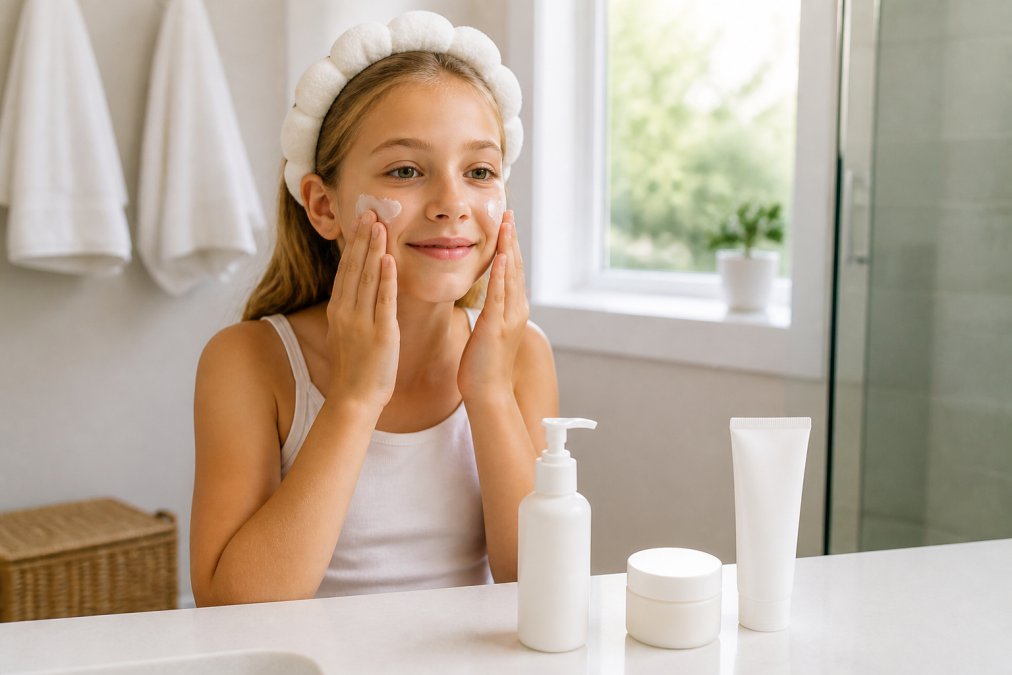
Cleanse, Moisturize, Protect
Cleanse. Use a gentle, pH-balanced cleanser morning and night. Our Glow Wash is pH-balanced, sulfate-free, and fragrance-free, and it works for every skin type. It removes dirt and oil without leaving skin tight. If skin feels squeaky after washing, the cleanser is too strong.

| Step | Product Type | When | What to Avoid |
|---|---|---|---|
| Cleanse | Gentle cleanser like Glow Wash | Morning and night | Sulfates, fragrance, scrubs |
| Moisturize | Lightweight cream | After cleansing | Heavy oils, pore-clogging formulas |
| Protect | SPF 30+ | Every morning | Spray-only application on faces |
Dermatologist Recommended Skincare for Tweens
Dermatologist recommended skincare for tweens follows one principle: support the barrier, do not attack the skin. Pediatric dermatology guidance consistently favors gentle, hypoallergenic formulas over trend-driven actives.
What to Look for on Labels
- Fragrance-free rather than unscented
- Non-comedogenic, so it will not clog pores
- Hypoallergenic, meaning lower likelihood of reaction
- Dermatologist-tested as a starting filter, not a guarantee
- pH-balanced, close to skin's natural acidity
Patch-test any new product on the inner forearm for 24 hours before it goes on the face. A common mistake is introducing three new products at once. If a reaction appears, you will not know which one caused it. Add one product at a time, with a week between additions.
The Psychological Impact of Skincare Trends on Tweens
The psychological impact of skincare trends on tweens is the part most guides skip. Skincare content now reaches children through short-form video long before they have a skin concern, and the messaging is rarely about health. It is about flawlessness.
What that produces:
- A belief that skin is a problem to be fixed
- Anxiety about pores, texture, and "glass skin"
- Pressure to own products their friends own
- A habit of over-checking the mirror
Why This Hits Tweens Harder Than Teens
A tween's sense of self is still forming. Around ages 9 to 12, kids shift from describing themselves in concrete terms ("I am good at soccer") to abstract ones ("I am likable"). That is also the age when social comparison sharpens. A 10-year-old scrolling a filtered routine video is not just seeing a product, she is measuring herself against a face that does not exist without a ring light and a smoothing filter.
The 'Sephora Kids' Pattern
The "Sephora Kids" phenomenon, tweens crowding beauty aisles for adult-strength serums and retinols, is usually framed as a spending story. It is really a belonging story. The products function as social currency. Owning the same serum as a friend signals membership in a group.
What Parents Can Actually Do
- Separate the product from the identity. "You are not your skin" is more useful than "that serum is bad for you."
- Cap the input, not the interest. Limit short-form beauty content the same way you would limit any other feed. The algorithm rewards extremes.
- Name the filter. Point out that the skin in the video has been smoothed, lit, and edited. Tweens respond to being let in on the trick.
- Watch for warning signs. Withdrawal from activities, mirror-checking that interrupts meals or school, or tearful reactions to a single blemish are reasons to talk to a pediatrician or child therapist, not just to change products.
- Give them a real win. A simple routine they can complete in two minutes gives them a sense of control without feeding the comparison loop.
The fix is not banning skincare. It is reframing it. A routine should be positioned as hygiene and self-care, the same as brushing teeth. It should not be a project with a before-and-after.
How to Talk to Your Tween About Skincare
How to talk to your tween about skincare matters as much as which products you buy. The goal is a child who understands their skin and does not tie their worth to it.
Try these approaches:
- Lead with function. "This keeps your skin comfortable and protected" beats "this clears up your skin."
- Explain the why. Tweens respond to reasoning. Tell them why harsh actives backfire.
- Set the routine together. Let them choose the order or the scent. Ownership drives consistency.
- Name the marketing. Point out when an ad is selling insecurity rather than a product.
- Model it. Your own routine, kept simple, teaches more than any lecture.
Frequently Asked Questions
What skincare brands are safe for tweens?
Look for brands formulated specifically for young skin, with gentle botanical ingredients and no harsh actives. The safest options are fragrance-free, hypoallergenic, and dermatologist-tested. Brands like Journee Bloom are designed by esthetician moms for tweens and teens, using gentle cleansers, lightweight moisturizers, and hydrating serums rather than retinol or exfoliating acids. Always check labels for parabens, phthalates, and synthetic dyes, and patch-test new products on the inner arm before applying to the face.
Which skincare ingredients should tweens avoid?
Tweens should avoid retinol, exfoliating acids (like glycolic and salicylic acid in high concentrations), and strong vitamin C serums, which can irritate young skin and disrupt the skin barrier. Also skip products with endocrine disruptors such as parabens and phthalates, plus synthetic dyes and heavy fragrances. These ingredients can cause redness, dryness, and sensitivity. Instead, choose pH-balanced, fragrance-free formulas with gentle hydrating ingredients like hyaluronic acid, panthenol, and glycerin.
At what age should a child start a skincare routine?
Most dermatologists suggest a simple routine can begin around age 10 or 11, when puberty starts and oil production increases. At this age, a gentle cleanser, lightweight moisturizer, and daily sunscreen are enough. There is no need for serums, toners, or exfoliants unless a dermatologist recommends them. Starting early with a simple routine helps tweens build healthy habits without overwhelming their skin or their schedule.
Is clean skincare safe for tweens with sensitive skin?
Yes, clean skincare can be safe for tweens with sensitive skin, but not all 'clean' products are gentle. Look for fragrance-free, hypoallergenic, and non-comedogenic formulas that are pH-balanced. Avoid essential oils and botanical extracts that can trigger reactions. A hydrating cleanser and a lightweight moisturizer made with goat milk, honey, or hyaluronic acid can support the skin barrier without irritation. Always introduce one product at a time and stop use if redness or itching occurs.
How do I know if a skincare product is non-toxic?
Check the ingredient list for parabens, phthalates, synthetic dyes, and heavy fragrances. Non-toxic products typically list gentle, recognizable ingredients and avoid endocrine disruptors. Look for third-party certifications or dermatologist-tested claims. Brands that provide full ingredient transparency and avoid harsh actives are your best bet. If a product claims to be 'clean' but lists retinol or exfoliating acids, it is not appropriate for tween skin.
What is a simple skincare routine for 10 year olds?
A simple routine for a 10-year-old has three steps: cleanse, moisturize, and protect. In the morning, rinse with a gentle cleanser, apply a lightweight moisturizer, and finish with sunscreen. At night, cleanse again and moisturize. That is it. No serums, no toners, no exfoliants. This routine takes two minutes and helps build healthy habits without overwhelming young skin or encouraging unrealistic beauty standards.